The modern automotive chemical market requires contactless shampoos to strike a balance between high cleaning power and safety for paintwork, chrome, and plastic. In practice, however, car wash owners often face the problem of unstable foaming: due to the specific characteristics of the water or equipment, a premium concentrate forms a thin, runny emulsion—rather than a thick “blanket of foam”—that instantly runs off the car’s body. Attempts to resolve this by artificially increasing the dosage lead to excessive chemical consumption, higher washing costs, and the risk of damaging the vehicle’s exterior components.
To address this technical shortfall, a separate category of additives has been developed: foam activators, or Foam Boosters. A foam booster is a specialized chemical enhancer that does not replace the main components of active foam, but rather radically modifies its physicochemical properties, stabilizes its structure, and adapts the working solution to adverse operating conditions and hard water.
What Affects the Stability of Active Foam on a Car's Body
To understand how the Foam Booster activator works, it is necessary to refer to the fundamental laws of colloid chemistry and the hydrodynamics of foam systems. Automotive foam itself is an unstable thermodynamic system consisting of a dispersed phase (air or gas) and a dispersion medium (an aqueous surfactant solution).
Molecular engineering of the “liquid–gas” interface is based on the behavior of diphilic surfactant molecules. A surfactant molecule has a hydrophilic (“water-loving”) polar head and a lipophilic (“fat/air-loving”) nonpolar tail. Upon initial dissolution and subsequent saturation of the mixture with compressed air in a effervescent tablet, the surfactant molecules instantly orient themselves at the phase boundary: the hydrophilic heads remain in a thin film of water, while the lipophilic tails are pushed into the air bubble.
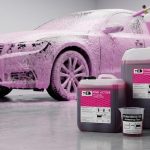
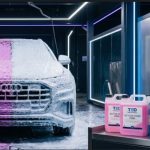
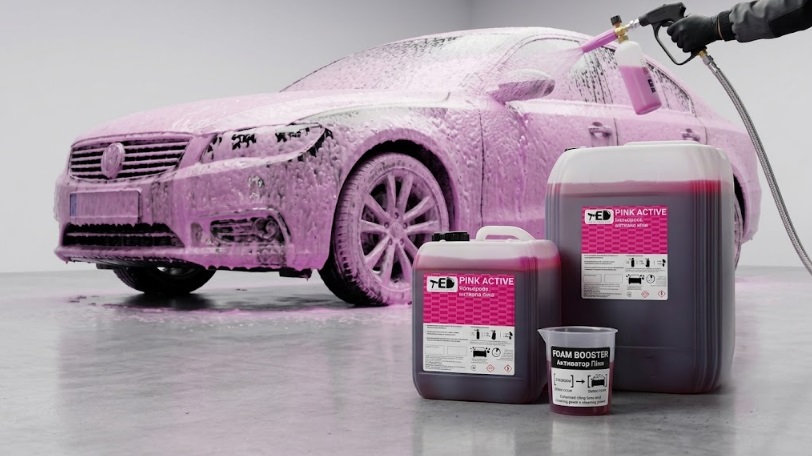
Standard car shampoos are most often based on anionic surfactants, which have excellent initial cleaning power but form a molecular layer with high internal repulsion between like-charged polar groups. This is where Foam Booster comes into play. Professional activators contain specially selected co-surfactants—most commonly amphoteric amido propyl betaines or nonionic amine oxides. The co-surfactant molecules embed themselves in the gaps between the anionic surfactant molecules, shielding the electrostatic repulsion of their heads and ensuring the densest, most condensed packing of the monomolecular layer at the phase boundary. The product is designed to interact directly with any alkaline-active foam (Master, Powerful, Prime, OneTouch, Rodeo, etc.), instantly transforming it into an ultra-dense, bright pink “creamy” cap.
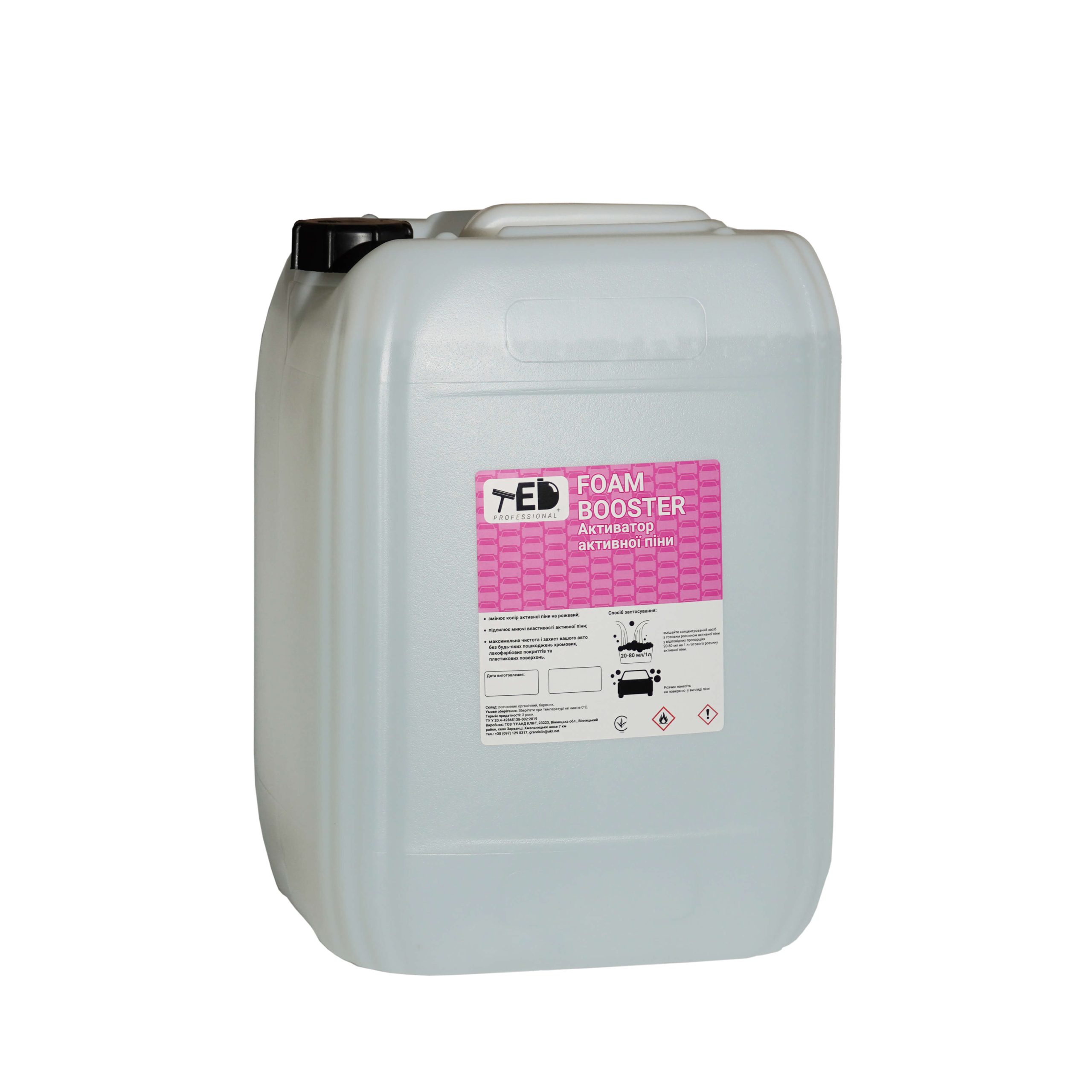
Foam Booster – Pink Foam Activator
Price range: from 1,068.00 ₴ to 3,735.00 ₴Select options This product is available in several variations. You can select the options on the product page.
How Hard Water and Temperature Affect Active Foam: When Foam Booster Is the Only Solution
Under real-world operating conditions at car washes, the chemical components of car shampoos are constantly exposed to the harsh effects of the external environment. There are two main destructive factors capable of completely rendering even the most expensive touchless car wash chemicals ineffective.
Hydrochemical factor: Critical water hardness
Water supplied to car washes from wells or municipal networks without extensive treatment via industrial reverse osmosis systems or sodium-cation exchange softening contains high concentrations of dissolved alkaline earth metal salts—primarily calcium (Ca²⁺) and magnesium (Mg²⁺) salts. When the hardness level exceeds 7–10 mg-eq/L, irreversible chemical deactivation of the car shampoo’s base formulation begins. The polar, hydrophilic heads of anionic surfactants (such as alkyl ether sulfates or linear alkylbenzene sulfonates) instantly react with Ca²⁺ and Mg²⁺ ions, forming chemically inert, water-insoluble organo-mineral salts (so-called “calcium soaps”).
These salts precipitate out, completely losing both their cleaning and foaming properties. The chemical solution “coagulates,” a weak emulsion forms on the car’s body, and a grayish film of salt deposits remains on the car’s surface after rinsing.
Foam Booster acts as a powerful auxiliary complexing agent and chelating agent. The special components in its formulation have a significantly higher stability constant for binding with hardness ions than standard surfactants. The booster acts as a “chemical shield”: its molecules are the first to attack and reliably encapsulate (chelate) free Ca²⁺ and Mg²⁺ ions, converting them into stable water-soluble complexes. At the same time, the amphoteric and nonionic co-surfactants in the activator are completely indifferent to the presence of hardness salts—they do not react with them and continue to stabilize the foam monolayer. As a result, the car shampoo fully retains the cleaning power specified by the manufacturer, even in extremely hard industrial water.
Temperature Fluctuations (Winter and Summer Regulations)
The effectiveness of surfactants depends directly on the kinetic energy of the system, which is determined by the temperature of the environment and the process water.
- Winter: As the temperature of the water and the vehicle’s body metal drops to +2…+5°C, the critical micelle concentration (CMC) increases sharply. Surfactant molecules lose their mobility, the rate at which they reach the phase boundary decreases, and the process of mechanically breaking down foam becomes more difficult. The chemical becomes viscous in the canister but remains liquid when sprayed. Foam Booster restores and optimizes the system’s hydrophilic-lipophilic balance (HLB), lowering the temperature threshold for micelle formation. This allows the surfactants to rapidly aggregate into micelles and form stable foam even at extremely low temperatures.
- Summer: The opposite problem arises in the summer, when the car’s body heats up in the sun to +50…+60°C. When using regular car shampoo, the water in the thin foam films evaporates instantly. The foam breaks down, and the concentrated alkaline residue dries on the paint, forming stubborn alkaline stains that can later be removed only through deep abrasive polishing of the body. The Foam Booster activator significantly slows down the dehydration process. The foam blanket acts as a thermal insulator: it cools the metal surface, traps water within its structure, and prevents active chemicals from drying on the paintwork throughout the entire washing process (up to 3–5 minutes).
How Car Wash Equipment Affects Foam Quality: Compensating for Technical Shortcomings
Ideal conditions for applying automotive chemicals require fully functional, properly calibrated equipment. However, a thorough technical audit of most operating self-service car washes (SSCWs) and traditional car wash bays often reveals a whole range of hidden engineering defects that prevent the achievement of a thick coating.
- Operation under unstable or low pressure conditions: High-quality mechanical foaming of the solution requires a stable operating pressure in the system within the range of 120–150 bar. During peak load hours on the MSO, pressure drops in the main line to 80–95 bar are frequently observed. With such a deficit in fluid flow energy, a standard foam nozzle is unable to draw in enough air for effective aeration. Instead of producing a fine spray, the spray gun begins to “spit out” a liquid, watery emulsion. The Foam Booster significantly reduces the energy barrier required for the initial dispersion of gas in the liquid, so a stable microporous structure forms even at low flow rates.
- Wear and Tear of Foaming Components (Compensating for the Human Factor): At the heart of any foam gun is the foam tablet—a compressed mesh made of fine stainless steel wire. Over time, it becomes clogged with hard microparticles, undergoes calcination, and experiences a natural loss of wire elasticity due to constant water hammer, which leads to an increase in the diameter of the passage holes (the mesh “thins out”). When the foam assembly is worn out, air passes through it in large bubbles that burst instantly. Foam Booster chemically compensates for the mesh’s mechanical shortcomings: the high surface elasticity of the activated solution allows even large gas bubbles to remain stable, quickly breaking them down as they exit the nozzle. This allows the car wash owner to significantly extend the maintenance interval between tablet replacements.
- Specific Features of MCO Systems with Dosing Systems (Dosatrons): In modern washing complexes, the prepared working solution is transported through long main pipelines, via swivel arms (pantographs) and rubber hoses, directly to the spray gun at the station. At large facilities, the length of this route can reach 30–50 m. When flowing under high pressure in conventional solutions, premature separation of the mixture often occurs due to constant friction against the pipe walls. Foam Booster acts as a powerful structural stabilizer for the foam mixture, maintaining the mixture’s micellar stability along the entire length of the pipeline all the way to the nozzle outlet.
Car Body Cleaning Process: Why Visual Density Affects the Result
There is a myth among car owners that thick foam is just a nice visual effect (“show effect”) designed to attract customers. However, colloidal chemistry proves the opposite: the structure and density of the foam have a direct, immediate impact on the quality of contactless paintwork cleaning.
The "snow blanket" effect and adhesion
The main enemy of contactless car washing is gravity. The thin, sparse foam runs off the vertical surfaces of the car under its own weight within 30–40 seconds after application. During this short period of time, the surfactants simply do not have enough time to fully react chemically with road grime. The ultra-fine pink foam produced by adding Foam Booster has an extremely high static adhesion index. This foam blanket can consistently adhere to vertical body panels for 4–5 minutes without visible slippage, extending the chemical contact time (Time-to-Clean) by 3–4 times.
Capillary Absorption of Dirt (Absorption)
Road grime on a car is a complex conglomerate of solid, abrasive microparticles bound together by a stable organic “matrix” (oil films, fuel residues, bitumen traces). The mechanism of action of activated microporous foam is based on capillary suction processes. When dense foam rests on a dirty car body, negative capillary pressure builds up inside its Gibbs-Plato channels. The foam begins to act like a giant chemical sponge at the molecular level:
- The hydrophobic tails of the surfactants penetrate the fatty matrix of the dirt, break it down, and separate it from the varnish.
- Individual dust and abrasive microparticles are wetted by the working solution, lose their adhesion to the coating substrate, and are drawn into the foam cells by capillary forces (the encapsulation process).
- The dirt is completely suspended (in a suspension) within the foam.
Outdoor Security
Solid dirt particles are highly abrasive. If dirt that has not been properly encapsulated in foam is rinsed off with a powerful water jet, these sand particles begin to scrape across the paint, leaving microscopic scratches (“spiderwebs”) on it. Foam Booster-activated foam creates a thicker, more resilient hydrodynamic cushioning layer on the vehicle’s body. It completely isolates solid dirt particles from direct contact with the paint, ensuring maximum safety during the process.
Economic Analysis (B2B Math for Business Owners)
For the owner of a car wash complex, the introduction of any new chemical component must be clearly justified in terms of numbers and economic profitability. The common belief that purchasing an additional product (an activator) is an unnecessary expense is completely debunked by a detailed mathematical calculation of the cost price.
The Economic Trap of Increasing Concentration: When the quality of the foam deteriorates due to hard water, owners often increase the dosage of the base car shampoo in the dosing machine from 2% to 4%. Consumption of the expensive concentrate doubles, directly increasing costs. In addition, an excess of alkali accelerates equipment wear and increases the risk of damage to chrome-plated car parts.
An alternative using Foam Booster: Instead of increasing the shampoo concentration, the formulator keeps the base dosage at 1.5% and adds a precise amount of Foam Booster activator to the system (only 5–10 ml per liter of the final solution). Thanks to the synergistic effect of the surfactants, this minimal amount of booster increases the volume and density of the foam cap by 150–200%. At a usage rate of 5–10 ml per liter of the final solution, just 1 liter of Foam Booster pays for itself after 100–200 cars, and the total cost of chemicals used per wash cycle is 25–35% lower.
| Comparison Parameter | Option A: Double the shampoo concentration | Option B: Integration of the Foam Booster activator |
|---|---|---|
| Consumption of base concentrate | Increases by 100% (Overspending) | Decreases or remains at the baseline level |
| Cost of chemicals per car | High (a direct increase in business expenses) | Optimal (due to economical use of the booster: 1 liter per 100–200 cars) |
| Risk of damage to chrome/LFP | High (due to a critical increase in alkalinity) | Completely absent (pH remains within the normal range) |
| Final rinse speed | Slow-acting (excess lye is difficult to rinse off the body) | Quick-drying (the activated foam comes off easily under pressure) |
Optimizing Operational Time and the WOW Effect: At a car wash, time is a paid resource. If the foam works effectively, dissolving dirt in a short amount of time, the driver needs less time to rinse the vehicle. This reduces the vehicle’s dwell time in the bay by 15–20% and increases the facility’s throughput during peak hours. At the same time, creating a super-thick, lush pink foam with a pleasant scent creates a lasting psychological impression of a premium service that customers are willing to pay more for. They’ll come back and ask, “Where’s that pink foam?!”
Process Specifications and Mixing Charts
To achieve the maximum synergistic effect from using the Foam Booster activator, it is necessary to strictly follow the technical specifications and mixing charts.
Ratios for Different Types of Washing Equipment and Application Algorithm
-
Preparation of the solution and dosage: Prepare the active foam working solution as usual (set the dosing pump to 1–3% or dilute according to the foam kit instructions). Add Foam Booster directly to the foam kit or foam generator tank:
- 5 mL/L — a nice, thick pink foam;
- 7–10 ml/L — the richest, “creamy” head and the most intense, trendy pink color.
- Application: Apply the activated foam to a dry car.
- Drying Time: Allow the product to remain on the vehicle’s surface for 1–3 minutes. Thanks to special surfactant boosters, the foam adheres reliably for up to 4–5 minutes; however, it is important to closely monitor the process and prevent it from drying completely.
- Rinsing: Rinse off the foam along with the loosened dirt using a powerful stream of pressurized water, holding the spray gun 15–20 cm away from the car’s surfaces at an angle.
Common Process Errors and Their Consequences
Overconcentration of the booster (overdose): Attempting to make the foam even thicker by adding an excessive amount of activator (more than 2% in the working solution) leads to the opposite, negative effect. The surface viscosity of the films becomes so high that the foam loses its ability to absorb dirt through capillary action. Such an overconcentrated mixture is extremely difficult to rinse off the car body—once dry, it leaves stubborn, greasy streaks.
Mixing with inorganic acids: It is strictly prohibited to add Foam Booster to acidic cleaners (such as limescale removers or disc cleaners). The booster’s components (treated water, special surfactant boosters, dye, and fragrance) undergo irreversible chemical degradation in an acidic environment; the mixture forms flakes and can completely clog the equipment’s dispensing channels.
Use of Contaminated Process Water for Initial Dilution: When preparing stock solutions, only clean, filtered water should be used. The presence of mechanical impurities in the water causes the activator to begin reacting directly inside the container, thereby depleting its effectiveness even before it is sprayed onto the vehicle.
A Real Optimization Tool or a Marketing Myth?
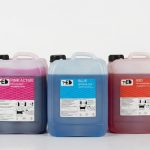
Based on a detailed physical, chemical, engineering, and economic analysis, a clear technical conclusion can be drawn: the Foam Booster foam activator is not a marketing ploy by the automotive chemicals industry, but a highly effective, practical tool for engineering optimization and business protection in the professional car wash sector. It ensures the stability of the contactless car body cleaning process by acting as a buffer that completely neutralizes the negative impact of human error, equipment design flaws, and destructive environmental factors. It is available in convenient 1-liter and 5-liter sizes with a long shelf life of 3 years.
A final process checklist has been developed to optimize operating costs and ensure sound management decisions.
Checklist: When is the integration of Foam Booster absolutely essential:
- A technical audit of the facility revealed that the water hardness level exceeds 6–7 mg-eq/L, and installing an industrial reverse osmosis system is currently not economically feasible.
- At the car wash complex, there are regular seasonal or peak drops in operating pressure in the AVT lines (below 110 bar).
- The design of the MCO stations is open-air (without protective walls against wind and sun), which causes automotive chemicals to dry out quickly in the summer and be subject to thermal shock in the winter.
- The cost of a single wash cycle at the facility exceeded the break-even point due to high consumption of basic shampoos.
- Competition in this area is very high, and the complex needs a major visual overhaul (featuring a trendy pink color scheme and increased density) to rapidly expand its customer base.
When you can choose not to use a booster:
- The washing facility is equipped with a flawlessly functioning, multi-stage water treatment system that consistently produces deeply softened, demineralized water with zero hardness.
- The equipment in the boxes has been completely upgraded, the system pressure remains stable at 150 bar, and the foam tablets undergo weekly routine inspections.
- This product uses the latest-generation premium formulations from TED Professional, into which the manufacturer incorporated a balanced amount of internal activators and co-surfactants during the synthesis stage.
Foam Booster – Pink Foam Activator
Price range: from 1,068.00 ₴ to 3,735.00 ₴Select options This product is available in several variations. You can select the options on the product page.
Frequently Asked Questions
1. What is Foam Booster, and what is it used for?
Foam Booster is a concentrated, professional-grade pink foam activator. It instantly transforms any alkaline active foam into an ultra-thick, bright pink “creamy” foam cap, while also adding a pleasant scent to the washing process. Using it creates a striking “WOW” effect that helps car wash facilities stand out from the competition.
2. Does the activator replace regular active foam?
No, Foam Booster is not a standalone car shampoo. It is a density and brightness booster that works exclusively in combination with any alkaline active foam (such as Master, Powerful, Prime, OneTouch, Rodeo, etc.), significantly improving its physical and visual properties.
3. How does Foam Booster affect the density and color of the working solution?
The activator increases the density of the foam 2–3 times and gives it a bright, trendy pink color. This combination makes the touchless car wash experience unforgettable for car wash customers.
4. What is the correct dilution ratio for the Foam Booster activator?
This product is extremely economical to use. Only 5–10 ml is added per 1 liter of the prepared active foam solution. The ratio depends on the desired result:
- 5 mL/L — to produce a nice, thick pink foam;
- 7–10 mL/L — to achieve the richest, “creamy” head and the deepest color.
One liter of Foam Booster concentrate is enough to treat 100–200 cars.
5. What is the correct step-by-step procedure for using the activator?
The process is very simple and consists of the following steps:
- Prepare a working solution of your usual active foam (using a dosatron at 1–3% or a foam kit).
- Add Foam Booster directly to the foam kit or foam generator tank at a ratio of 5–10 ml per liter.
- Apply the pink foam to the dry car.
- Let the product sit on the car body for 1–3 minutes, making sure it doesn't dry out.
- Rinse thoroughly with a strong jet of pressurized water, holding the spray gun 15–20 cm away from the surface at an angle.
6. How does using Foam Booster affect how long the foam lasts on the car's body?
Thanks to the special surfactant boosters in its formulation, the product significantly enhances the adhesion of the cleaning solution. The activated pink foam can remain stable on vertical and sloped surfaces of the car’s body for up to 4–5 minutes, which improves overall cleaning performance.
7. What is the chemical composition of the activator, and what is its shelf life?
Foam Booster contains: treated water, special professional surfactant boosters, a safe dye, and a fragrance. The official shelf life of the concentrate is 3 years from the date of manufacture. The product is available in convenient 1-liter and 5-liter sizes.
8. What safety precautions must be followed when working with the concentrate?
Since this product is a highly concentrated professional-grade solution, you must strictly follow basic safety rules when using it: keep the container out of the reach of children and be sure to wear protective gloves.