
As a formulator of professional automotive and household cleaning products for the HoReCa sector, I’m regularly asked: Which is better to use in professional dishwashers—gel or tablets? At first glance, the difference seems to be only in the format, but in practice, this choice directly affects the equipment’s lifespan, cleaning consistency, and business costs.
Many businesses choose tablets for convenience, without taking into account the technical specifications of professional systems. These systems have completely different chemical requirements than their household counterparts. Choosing the right product is the key to ensuring the longevity of your equipment and impeccable hygiene.
Comment from the process engineer
Dosing control plays a key role in commercial dishwashers. Commercial equipment is connected to dosing pumps that operate exclusively with liquid concentrates. Using tablets in such systems is not only ineffective but also dangerous for the machine’s hydraulic system.
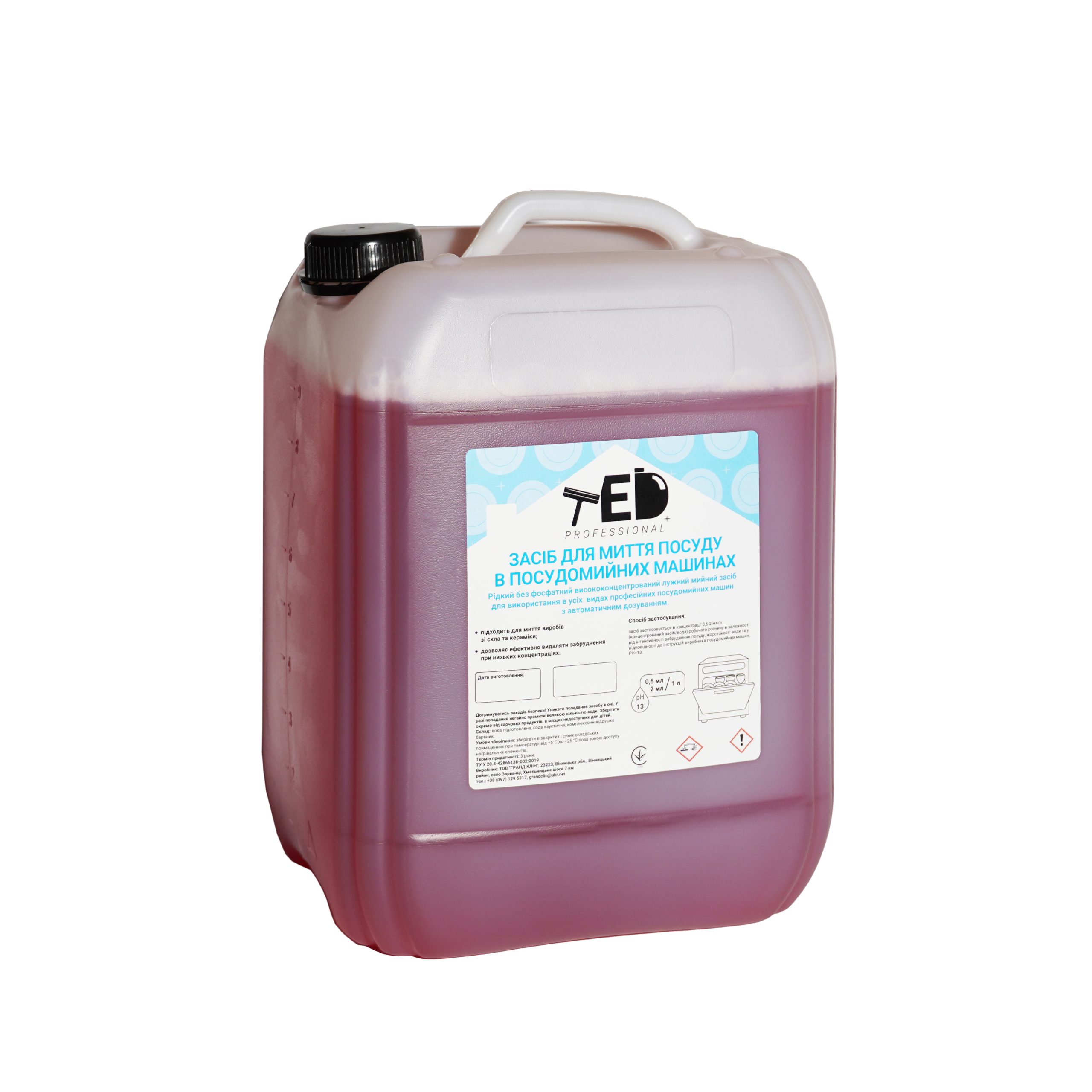
TED Professional Dishwasher Detergent (Gel)
1450,00 ₴Select options This product is available in several variations. You can select the options on the product page.
How a Commercial Dishwasher Works
A commercial dishwasher is an engineered system that operates under high pressure and at high temperatures. It is equipped with heating elements, circulation pumps, spray arms, and—most importantly—automatic dosing pumps. Each of these components is sensitive to the composition of the detergent.
The wash cycle consists of specific phases: washing, rinsing, and drying. Each phase requires a consistent concentration of detergent. Any deviation can result in reduced wash quality or damage to internal components.
Chemical composition: gel vs. tablets
A gel is a homogeneous liquid formulation containing surfactants, alkalis, and complexing agents in a stable dissolved state. It mixes instantly with water, ensuring uniform distribution of the active ingredients from the very first second of the cycle.
Tablets are compressed products of varying densities. They dissolve in layers, and this process is not always predictable. In professional equipment, this creates an uneven chemical load that the system is not designed to handle.
Dosing control is a critical factor
Professional machines use automatic dosing (peristaltic pumps). The gel is ideal for such systems: the pump dispenses milliliters of the product precisely according to the load volume. This guarantees perfect results without waste.
The tablets come in fixed doses. You cannot adjust them based on the size of the load or the level of soiling. The result is either “unwashed” dishes or an excess of detergent, which then requires additional, lengthy rinsing.
Impact on Equipment
This gel for professional dishwashers is safe: it does not leave residue or clog the spray arms. This is critical for the health of the pumps and for maintaining stable circulation.
Tablets that are intended to be “adapted” for use in commercial machines often leave undissolved particles behind. These particles accumulate in the filters, clog the nozzles, and cause the heating elements to overheat. This is the most common cause of unscheduled repairs.
Water Hardness and Efficiency
Hard water inhibits the action of surfactants and promotes scale buildup. Therefore, it is important to use cleaning products containing powerful complexing agents. TED Professional gels are specifically designed to neutralize hardness salts.
Always use professional rinse aids for a sparkling finish. They reduce the surface tension of water, preventing spots even in hard water.
Cost-Effectiveness and Safety
Tablets may seem cheaper, but that’s an illusion. The high likelihood of overuse, the strain on the system, and the risk of breakdowns cancel out any savings. The gel allows for precise control over consumption, stabilizes the machine’s operation, and reduces service costs.
Regarding sanitation requirements: if a tablet does not dissolve completely, there is a risk of chemical residue on the dishes. Professional-grade gels rinse out completely, which is a safety standard for the HoReCa industry.
Case Study
I recently worked with a restaurant where the use of tablets in a commercial machine had caused scale buildup in the circulation system. After switching to a commercial gel-based system and performing scheduled descaling, water pressure was restored, and maintenance costs were reduced by 30%.
The Specialist's Technical Verdict
As a process engineer, I can confidently say that gel is the technologically sound solution for professional equipment. It ensures stability, precise dosing, and equipment safety. Tablets are designed for home use, where there are no automated dosing systems. For businesses that value stability and cost savings, gel is the only right choice.
TED Professional Dishwasher Detergent (Gel)
1450,00 ₴Select options This product is available in several variations. You can select the options on the product page.
Frequently Asked Questions
Can these tablets be used in a commercial dishwasher?
Not recommended. Professional machines are designed for liquid concentrates dispensed by dosing pumps. Tablets can clog the nozzles and dosing pumps.
Why is professional gel more economical than tablets?
Thanks to automatic dosing, the pump dispenses exactly the amount of chemical needed for the cycle. The tablet is always slightly larger than necessary for an average cycle.
How can you tell if a cleaning product isn't right for you?
The main signs include the appearance of white scale, streaks on dishes, reduced pressure in the spray nozzles, or the machine overheating due to scale buildup.
Do I need conditioner if I'm using a high-quality shampoo?
Yes, the rinse aid is an essential part of the system. It ensures quick drying without spots or streaks, which cannot be achieved with detergent alone.
What should you do if there is already a buildup on the equipment?
You need to perform a descaling procedure using professional descaling products and review the water softener settings.