The exact dilution ratio of the active foam directly determines the profitability of a car wash business and the cleanliness of the vehicle’s body. A team of engineers from TED Professional conducted measurements of chemical consumption and wash quality at operating car washes and detailing stations. Our experience shows that mixing concentrates “by eye” consistently leads to two extremes. The owner either overpays every month due to excessive chemical consumption or loses customers because of a gray, static film left on washed cars.
The dilution range from 1:3 to 1:12 is there for a reason. The final concentration depends on the type of equipment you use, water hardness, the season, and the level of dirt on the car’s body. We’ve put together this practical guide so you can precisely adjust your dosing units, protect your car’s paint finish from alkali damage, and reduce the cost per wash cycle.
Why Is the Correct Concentration of Active Foam Important?
What Is KKM, and Why Does Overusing Chemicals Not Work?
Surfactants form the basis of any active foam. The main purpose of surfactants is to reduce the surface tension of water and separate dirt from the vehicle’s body. However, there is a clear rule in chemistry: adding concentrate to water improves the cleaning effect only up to a certain limit. This threshold is called the Critical Micelle Formation Concentration (CMFC).
As soon as the solution reaches its CMC, the surfactants are operating at peak efficiency. If you then increase the foam dosage on the dosing pump (for example, by raising the flow rate from 2% to 4%), the cleaning quality will not change. The chemical molecules begin to cluster into useless, bulky micelles in the water and are simply flushed down the drain. Our measurements show that exceeding the standard dilution ratio by 1.5% results in no improvement in cleanliness but increases the cost of purchasing car care chemicals by 30–40%.
How Active Foam Breaks Down Road Dirt
The road film on the vehicle body consists of mineral dust, soot, fuel residues, and fatty organic compounds. All of these components adhere firmly to the paint due to molecular attraction. The working foam solution must completely saturate this layer to weaken its bond with the surface.
The alkaline components in professional foam instantly react with the fatty base of the dirt, transforming insoluble deposits into easily rinsable soap. At the same time, surfactant molecules coat the microparticles of sand and dust, imparting a uniform electrical charge to them. The dirt particles begin to repel each other and the car’s paint, becoming suspended in the foam and easily rinsed away by a stream of water.
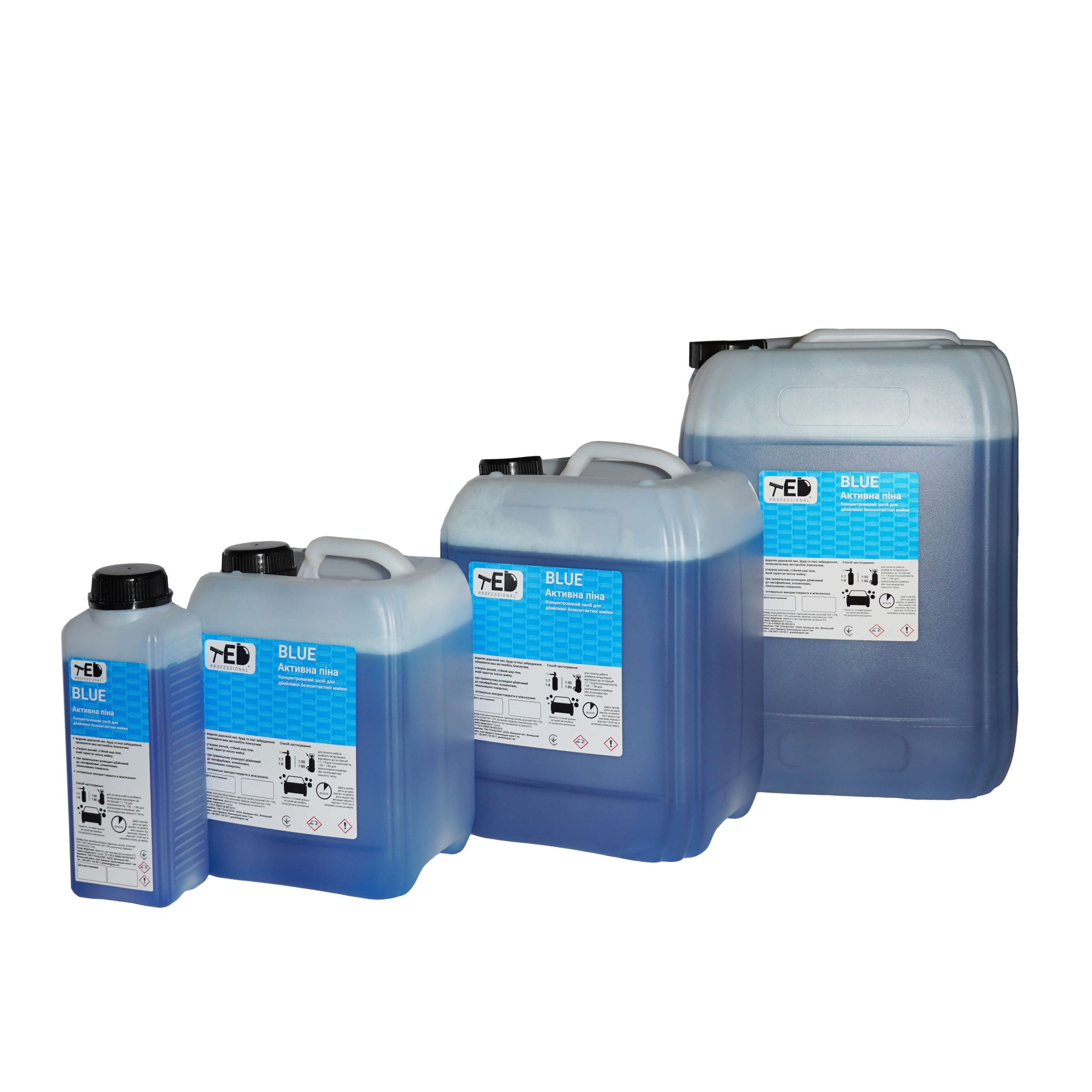
Blue Active Foam – 1:50 – 1:80 (concentrate)
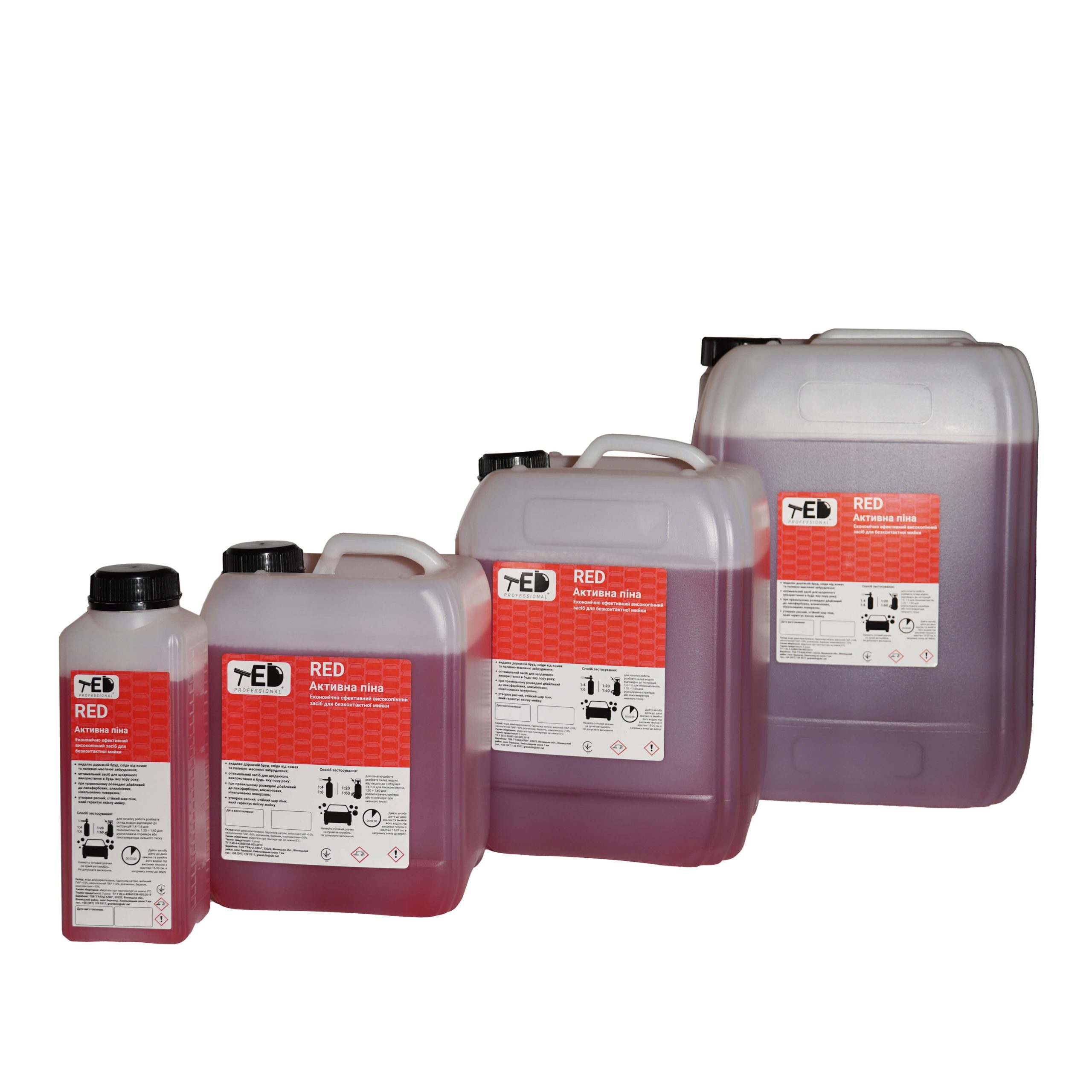
Price range: from 250.00 ₴ to 2,990.00 ₴Select options This product is available in several variations. You can select the options on the product page.RED Active Foam – 1:20 – 1:60 (concentrate)
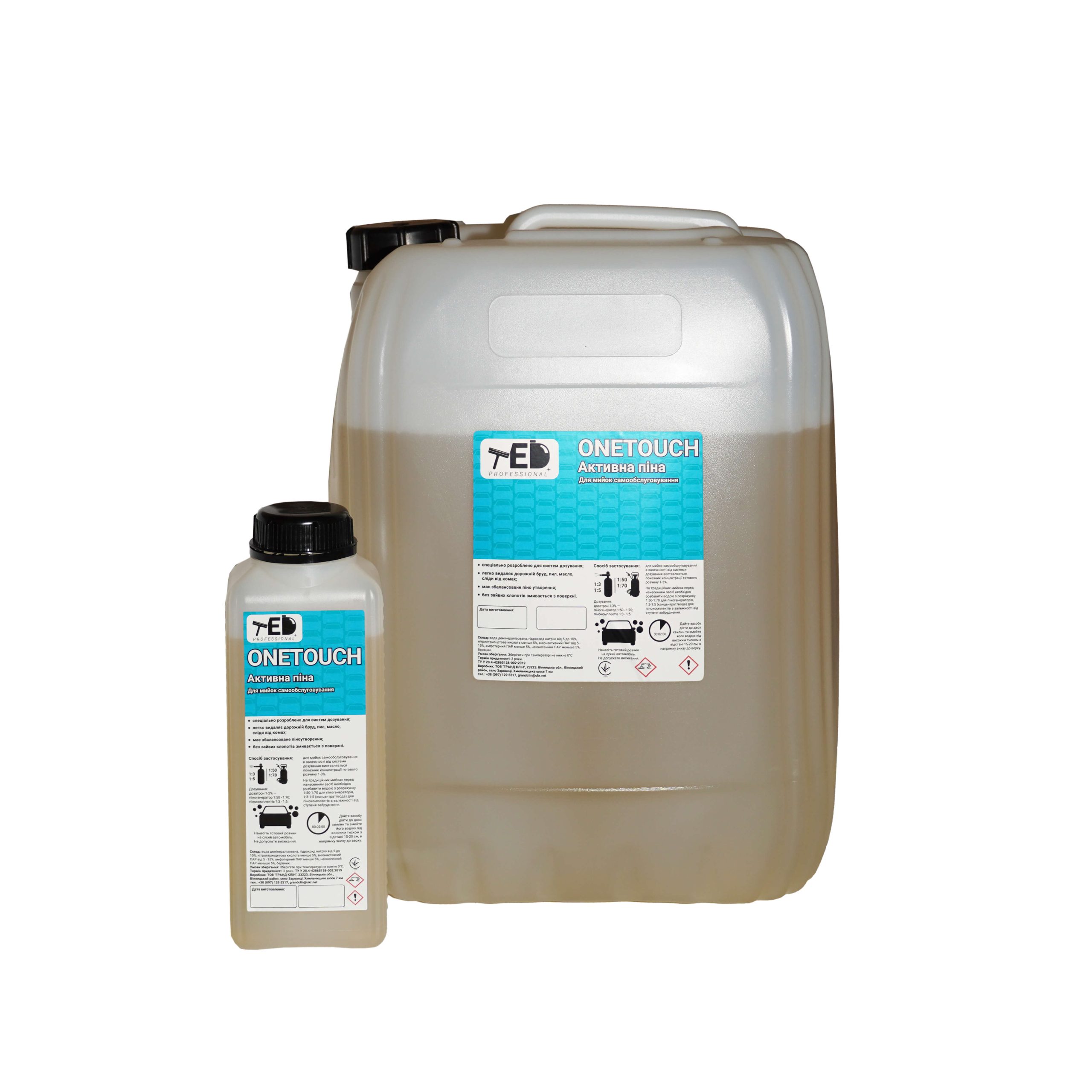
Price range: from 145.00 ₴ to 1,590.00 ₴Select options This product is available in several variations. You can select the options on the product page.OneTouch Active Foam – 1:50–1:70 (concentrate)
Price range: from 130.00 ₴ to 1,390.00 ₴Select options This product is available in several variations. You can select the options on the product page.
How to Prepare Foam for Different Types of Equipment
Mixing Ratios for the AVT Foam Nozzle (Foam Generator)
The foam nozzle for the high-pressure unit has a built-in injector. When water is supplied from the unit, a vacuum is created that draws the concentrate from the nozzle’s 1-liter tank. It is important to take into account the mixing ratio of clean water from the fire truck’s water supply line.
A standard high-pressure sprayer dilutes the tank’s contents with water at a ratio of approximately 1:10. Therefore, when you prepare a solution in the foam nozzle’s tank at a ratio of 1:5, the resulting working mixture sprayed onto the vehicle’s body actually has a concentration of about 1:60 (1.6%). This is precisely why manufacturers specify concentrated dilution ratios in the tank ranging from 1:3 to 1:12 for foam nozzles.
How to mix foam for a foam generator and foam kit
An industrial foam generator with a capacity of 25, 50, or 100 liters is powered by compressed air from a compressor. In this system, no additional water is mixed in during operation: the foam applied to the vehicle will have the same concentration as the solution you poured into the tank.
For large foam generators, use direct working dilution ratios ranging from 1:50 to 1:100 (i.e., 10 to 20 ml of concentrate per 1 liter of water). It is strictly prohibited to fill the foam generator with a 1:5 solution, as this will result in a corrosive chemical concentrate being applied to the vehicle.
Setting Up the Dosatron at a Self-Service Car Wash
Dosatron volumetric dispensers at self-service car washes dispense chemicals automatically directly from the canister. The flow rate is adjusted on the dispenser’s scale in percentages (for example, 1%, 1.5%, or 2%).
Take the viscosity of the automotive chemicals into account. Thick, highly concentrated products create greater resistance during suction. We recommend checking the dosing units using the weighing method: place the container with the chemical on a scale and monitor the exact flow rate in grams over 10 operating cycles of the spray gun.
Active Foam Dilution Table: 1:3–1:12, by Season and Dirt Level
Calculation data from our engineering department regarding the selection of mixing ratios for AVT foam nozzles and dosing equipment:
| Type of pollution and seasonality | Mixing ratio for the foam nozzle (AVT) | Concentrate for a foam generator / Dosatron | Target pH of the solution | Aging time |
|---|---|---|---|---|
| Light summer dust (dry weather) | 1:10 – 1:12 | 0.8% – 1.0% (1:100–1:120) | 10.5 – 11.0 | 1.5–2 min |
| Typical urban pollution (spring/fall) | 1:7 – 1:9 | 1.2%–1.5% (1:70–1:80) | 11.5 – 12.0 | 2–3 min |
| Organic dirt, insect traces, and resin | 1:5 – 1:6 | 1.8% – 2.0% (1:50–1:60) | 12.0 – 12.5 | 3 min |
| Winter road treatment: chemicals, salt-sand mixture | 1:3 – 1:4 | 2.5%–3.0% (1:30–1:40) | 12.5 – 13.0 | 3–4 min |
How Do Water Hardness and Temperature Affect Foam Yield?
Car Care Product Consumption in Hard Water
Calcium and magnesium salts in hard water are the main enemies of automotive chemicals. Instead of cleaning the car’s body, surfactant molecules react with the hardness salts and form a residual precipitate (calcium soaps):
If the water hardness at the sink exceeds 10 mg-eq/L, you lose up to 40% of the foam’s active ingredient while it’s still in the tank. Car wash owners are forced to increase the concentration (for example, using a 1:4 ratio instead of 1:8). Installing a salt-based water softener brings chemical consumption back to normal levels and results in significant cost savings.
How to Make Foam in Winter and Summer
In cold water (below +10°C), chemical reactions slow down and the cleaning power of surfactants decreases. Therefore, during the winter months, the foam dosage is increased by 15–20% or the dilution concentration is raised.
Heating the water to +25…+35°C doubles the rate at which dirt is removed. The main rule is not to use water hotter than +45°C. Hot foam dries instantly on metal and leaves stains on the paint.
Why Is Foam That's Too Thick Dangerous for Cars?
The Effect of Highly Alkaline Foam on Chromium, Aluminum, and Rubber
Continuous use with an excessively high foam concentration (a 1:3 ratio when unnecessary) leads to the buildup of alkali on car parts. A solution with a pH level above 12.5 oxidizes aluminum moldings and chrome. White, discolored spots appear on them that cannot be washed off.
A high concentration of lye leaches the elastic components from rubber seals. The rubber around the glass becomes rough and, over time, develops cracks. Following the correct proportions keeps the trim in perfect condition.
How does active foam affect wax and ceramics?
A foam solution that is too aggressive quickly washes away protective coatings. Hard wax or polymer sealant will be completely removed from the body after just 1–2 washes with a concentrated alkaline solution (1:3).
Ceramic coatings are more resistant to alkali, but repeated washing with foam that is too concentrated gradually breaks down their hydrophobic layer. For cars with protective coatings, it is best to use milder mixtures (1:9–1:12) or special pH-neutral foams.
Mistakes Made When Mixing Active Foam
Why You Shouldn't Mix Foam "By Eye" or Based on the Color of the Solution
Trying to prepare a working solution “by eye” or based on the color intensity in the tank is the most common cause of financial losses at a car wash. Modern professional concentrated products from TED Professional have a high density and varying concentrations of dyes. The color of the prepared mixture in no way reflects the actual amount of cleaning agent in the water.
When a car washer adds chemicals without a measuring cup, the deviation from the standard can reach 30–50%. An excessive dosage risks burning the chrome or damaging the seals, while an insufficient dosage leaves the car body dirty. For consistent results, use only graduated measuring cups or scales.
Use of contaminated process water from storage tanks
Using unfiltered water from recirculation systems or open storage tanks to dilute the foam completely negates the cleaning effect of the car care product. Silt, sand, and bacterial film in such water instantly bind the surfactant molecules even before the solution is applied to the car.
In addition to deactivating the compounds, abrasive particles in dirty water clog the foam tablets and AVT nozzles within a few weeks of operation. Use only clean tap water or filtered industrial water to prepare the solution in the tank or foam generator.
Storing the diluted solution for more than 24 hours
When diluted in water, the active foam concentrate loses its properties during prolonged storage. In its diluted form, a slow process begins in which the active components undergo hydrolysis and the complexing agents—which are responsible for keeping dirt in suspension—break down.
As early as 24–36 hours after mixing in the foam generator tank, the cleaning power of the solution drops by 20–30%, even if it continues to foam well on the surface. Prepare only as much working solution as will be completely used up during a single work shift.
How to Test the Effectiveness of Diluted Foam in 3 Minutes
The "white napkin" test for static buildup
The simplest and fastest way to check the quality of a contactless car wash is to test it with a clean, dry cloth or cotton pad. After thoroughly rinsing off the foam with pressurized water and letting the car dry, wipe the lower part of the doors or fenders with a cloth.
If a gray or dark mark remains on the napkin, this indicates the presence of static residue. This means that the solution is too dilute, the water is too hard, or the foam was not left on long enough to break down the road film.
Monitoring the Height and Density of the Foam Blanket
The visual structure of the foam on the car body indicates that the equipment is properly adjusted and the concentration is correct. Optimal foam should have a microporous, monolithic structure, resembling shaving cream, and should slowly run down vertical surfaces.
If the foam immediately runs off in clear streams, the solution is too thin or the foam tablet is clogged. If, on the other hand, heavy flakes are sprayed onto the car body and immediately fall to the floor, the solution is too concentrated, and there isn’t enough air in the system for aeration.
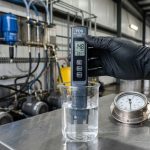
Measuring the pH of the working solution in the truck bed
To accurately monitor safety and effectiveness, use litmus paper or a portable digital pH meter. Apply the solution to the car body and place the test strip directly against the foam layer on the metal.
For standard touchless car washing, the pH level on the vehicle’s body should be between 11.5 and 12.5. A pH level above 13 indicates a dangerous overconcentration, which can damage aluminum and chrome-plated parts.
Economic Analysis: The Cost of a Dosage Error
For a car wash owner, overuse of chemicals due to improper dilution results in direct losses of net profit. Below is a comparative cost analysis for a car wash facility handling 1,000 cars using a standard active foam concentrate:
| Calculation Parameter | Incorrect dosage (1:4) | Optimal dilution ratio (1:8) | Business Variance and Losses |
|---|---|---|---|
| Concentrate consumption per vehicle | 200 ml | 110 ml | 90 ml overuse per machine |
| Cost per 1,000 vehicles | 200 liters (10 cans) | 110 liters (5.5 canisters) | 90 liters of chemicals were used in excess |
| Cost of chemicals per 1,000 cars | 22,000 UAH | 12,100 UAH | Overpayment: 9,900 UAH per 1,000 cars |
Losses from the premature replacement of clogged foam tablets
Using excessively high concentrations of chemicals in combination with hard water accelerates the caking of foam screens (tablets) in the spray guns. Excess alkali and salt precipitates clog the internal pores of the stainless steel screen within 3–4 weeks, instead of the standard 6 months of operation.
For a 4-bay car wash, the premature replacement of foam tablets, downtime of the bays, and the service technician’s labor costs add between 3,000 and 5,000 UAH to the monthly cost estimate. Precise dosing of the cleaning solution extends the equipment’s service life by 3–4 times.
Staff Safety and Occupational Safety When Working with Automotive Chemicals
Use of Personal Protective Equipment (PPE)
Professional concentrated contactless car shampoos have a high alkalinity (pH 13–14). They are classified as chemically aggressive substances, so working with them requires compliance with occupational safety regulations.
When transferring and diluting concentrates, personnel must wear thick rubber gloves (nitrile or neoprene), protective goggles or a clear face shield, and an apron made of chemical-resistant material. Drops of concentrate on unprotected skin can cause chemical burns and dermatitis.
First Aid if Concentrate Comes into Contact with the Skin or Eyes
If safety precautions are not followed and concentrated automotive chemicals come into contact with exposed skin or the eyes, take immediate action in accordance with the following procedure:
- Skin contact: Immediately rinse the concentrate off with plenty of cold running water for 10–15 minutes. Do not use acids (such as vinegar or lemon juice) to neutralize the acid, as this may cause an additional thermal reaction.
- Eye Contact: Rinse eyes with a gentle stream of clean water for 15 minutes, keeping the eyelids open. Seek medical attention immediately after rinsing.
- Spills on clothing: Remove contaminated clothing to prevent prolonged contact between the alkali and your skin, and rinse the affected areas of your body.
Step-by-Step Instructions: How to Properly Mix and Apply Foam
Follow these steps to ensure accurate dosing of car care products and safe washing.
Determine the water hardness level using test strips or titration. If the water is hard (more than 7 mg-eq/L), add an additional 10–15% of the concentrate to the standard dilution ratio.
Select the ratio from the table. For light summer dust, use a 1:10 ratio; for heavy winter mud, use a 1:4 ratio.
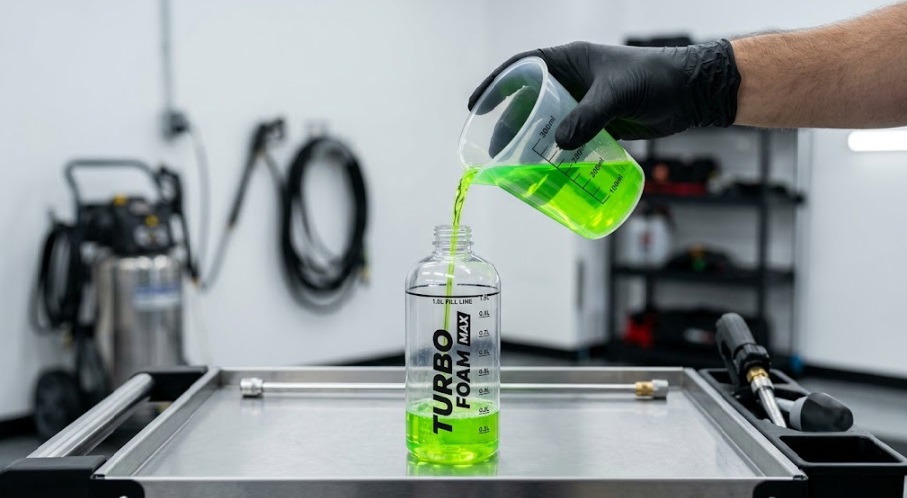
First, pour the required amount of water into the tank, and only then add the foam concentrate. This will prevent the tank from foaming up while you’re filling it.
Apply the foam in horizontal strokes from the sills to the roof. Let the product sit on the body for 2–3 minutes, then rinse it off with pressurized water.
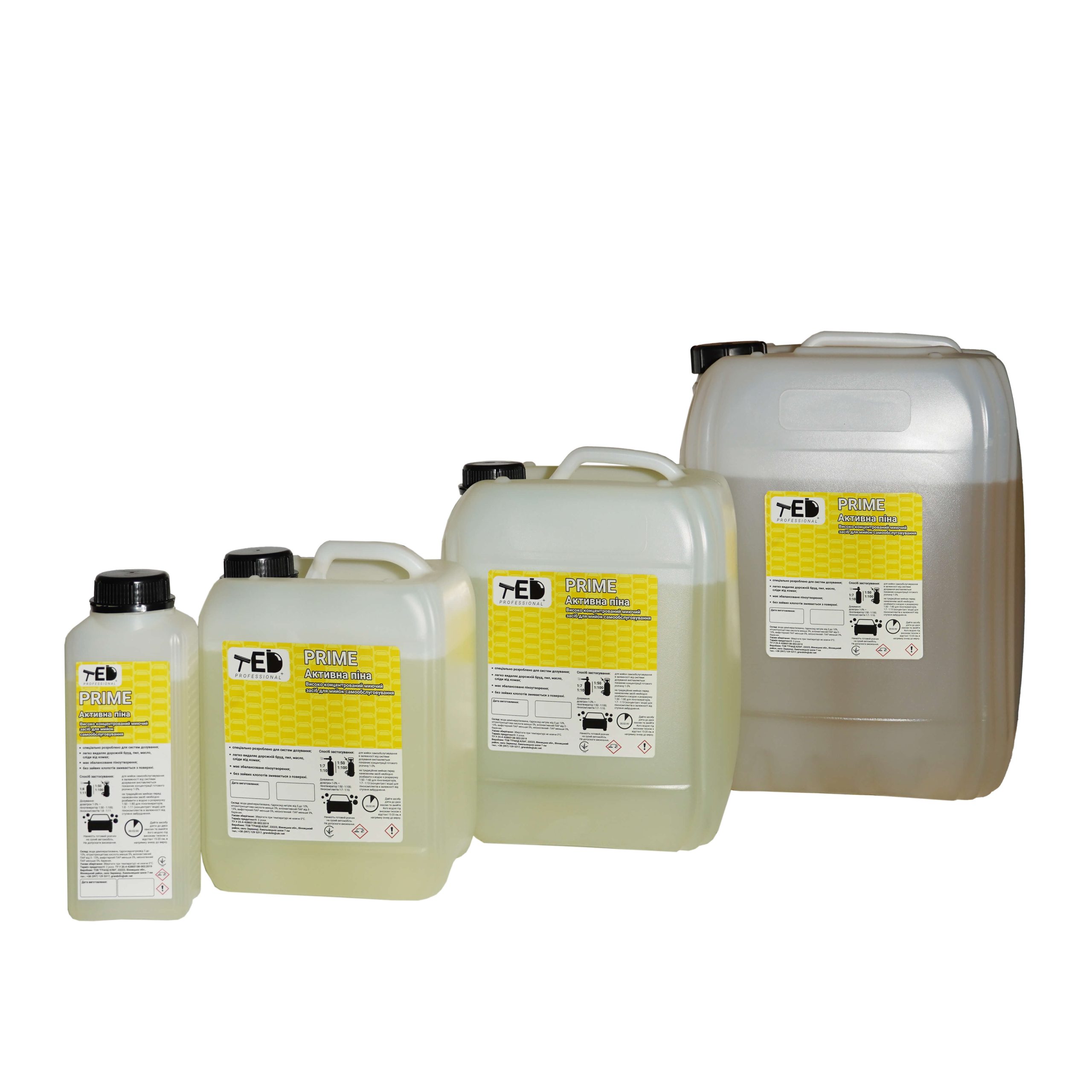
Prime Active Foam – 1:50 – 1:80 (concentrate)
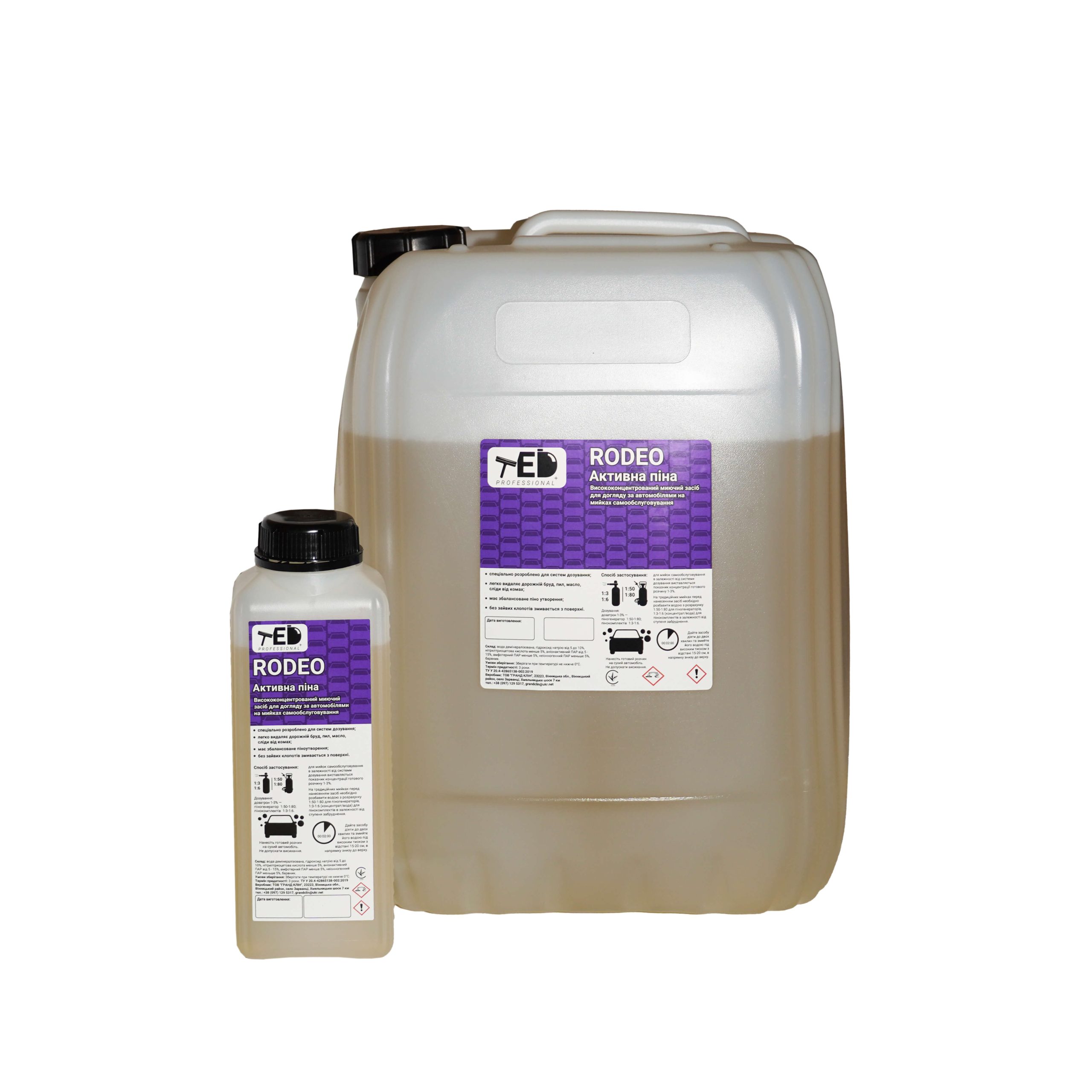
Price range: from 220.00 ₴ to 2,500.00 ₴Select options This product is available in several variations. You can select the options on the product page.Rodeo Active Foam – 1:50–1:80 (concentrate)
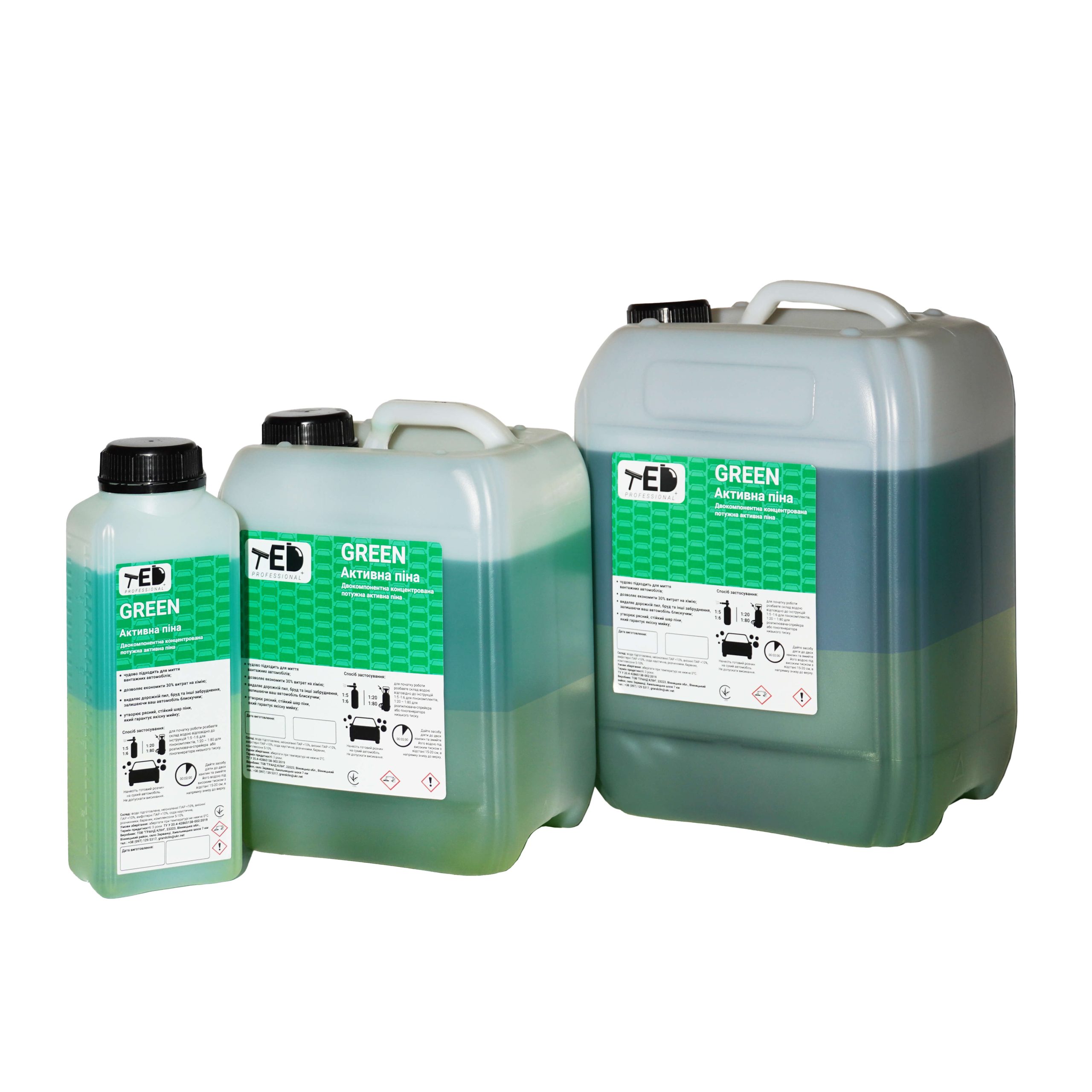
Price range: from 150.00 ₴ to 1,615.00 ₴Select options This product is available in several variations. You can select the options on the product page.Green Active Foam – 1:20 – 1:80 (concentrate)
Price range: from 180.00 ₴ to 2,080.00 ₴Select options This product is available in several variations. You can select the options on the product page.
Frequently Asked Questions
How do you properly mix 1 liter of foam for a foam nozzle?
To achieve a 1:5 ratio, pour 167 ml of active foam concentrate and 833 ml of water into a 1-liter tank (or 200 ml of concentrate to 800 ml of water for a 1:4 ratio). For a 1:10 ratio, mix 91 ml of the chemical solution with 909 ml of water (or 100 ml of the chemical solution per 900 ml of water for a 10% solution).
Can I pour undiluted active foam concentrate into the foam nozzle reservoir?
It is not recommended to pour undiluted concentrate into the foam nozzle. The product’s high viscosity impairs suction through the injector, and the resulting solution is too concentrated and may damage chrome moldings.
What should you put in the tank first: water or foam concentrate?
First, pour the required amount of water into the container, then add the automotive chemical concentrate. This sequence prevents excessive foaming in the tank during filling.
Why does the foam run off the car too quickly?
Rapid foam runoff is caused by a solution that is too dilute, low air pressure, or wear on the foam tablet in the nozzle. Replacing the mesh aerator restores the solution’s proper density and adhesion.
Does water temperature affect the dilution ratio?
Yes, in cold water (below +10°C), the activity of surfactants decreases. To maintain cleaning effectiveness, increase the amount of concentrate by 15–20% or use heated water.
What is the correct ratio for washing the engine with active foam?
To clean the engine compartment, use a 1:3–1:5 concentration with a foam nozzle. Let the solution sit for 3–4 minutes, then rinse it off with moderate water pressure.
How does changing the brand of foam affect the dosatron settings?
Different products vary in density and substance content. When switching to a new concentrate, a control weighing of the chemical absorption is performed.
Can hot water be used to dilute the foam?
The optimal water temperature ranges from +20°C to +35°C. Using water at temperatures above +50°C causes certain surfactant components to degrade and the solution to dry quickly on the metal.