In professional car detailing, at self-service car washes, hand car washes, and corporate car wash facilities, the speed at which work is performed directly affects the business’s profitability. As experts at TED Professional, we regularly analyze our partners’ operational processes and have observed a consistent pattern: the drying stage is most often the “bottleneck” that extends the time required to serve each customer. Even a perfectly washed car can lose its attractive appearance due to water streaks, residual droplets, or water seeping out again from hidden cavities.
Most car wash owners pay a lot of attention to choosing active foam, car shampoo, or high-pressure equipment, but they underestimate the importance of modern high-speed body dryers. In fact, it is the final stage that determines not only the quality of the finished result but also staff productivity, customer satisfaction, and the car wash’s throughput. A single properly selected product can reduce drying time by tens of percent without additional capital investment in expensive equipment.
Commentary by a TED Professional expert
As TED Professional experts, we recommend treating a quick dryer not as an auxiliary tool, but as a full-fledged step in the professional car care process. When used correctly, it speeds up surface drying, minimizes the appearance of mineral spots, enhances the shine of the paint finish, and significantly reduces the time the car spends at the car wash station.
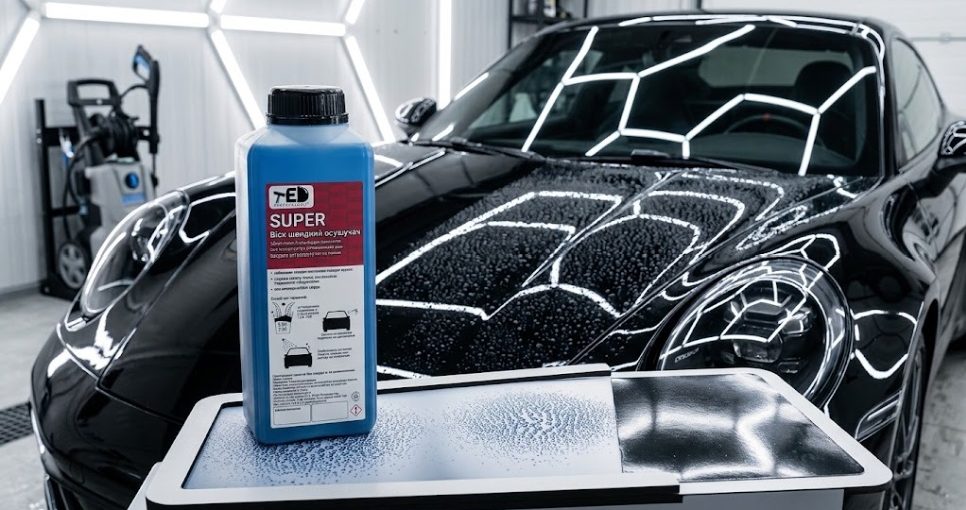
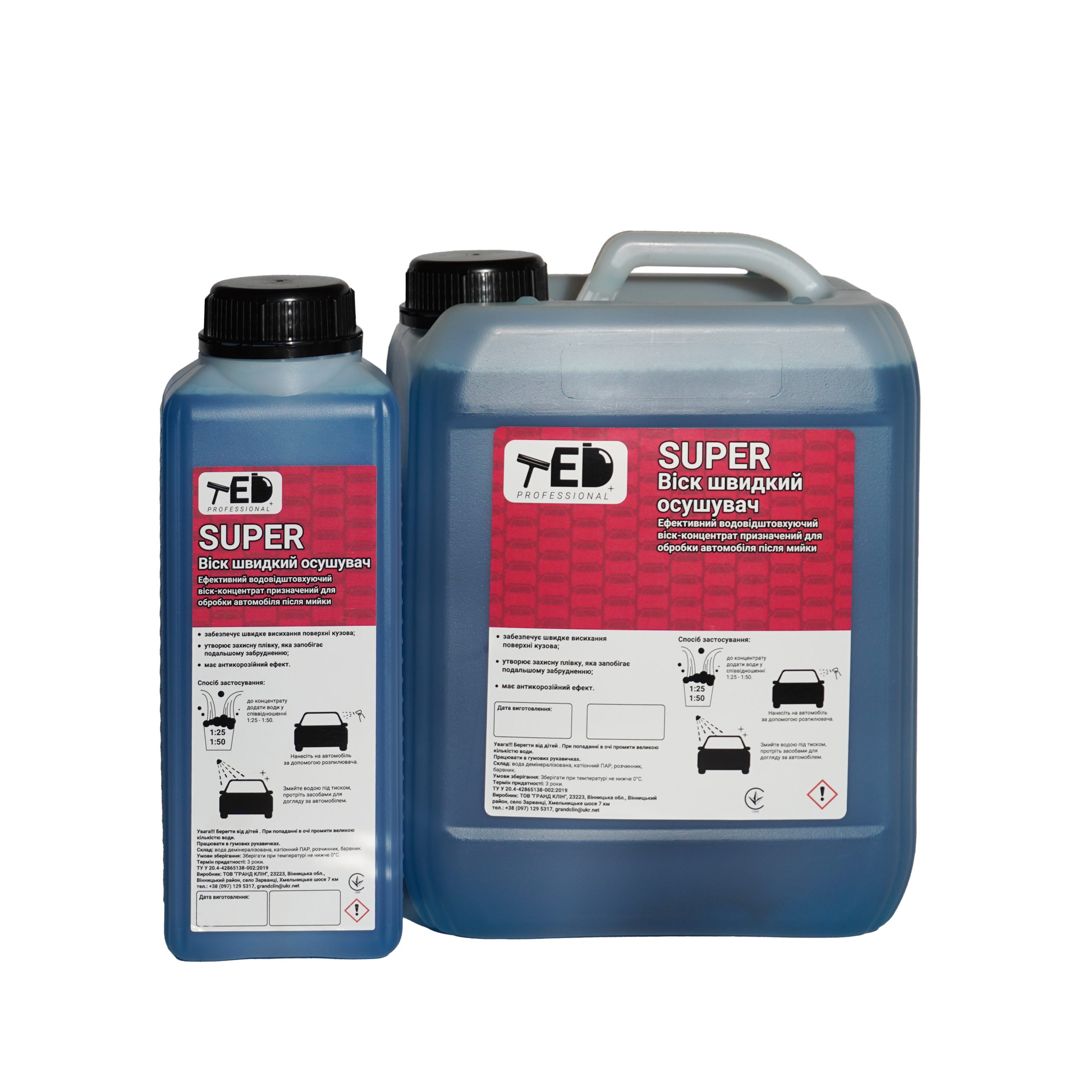
Super Quick-Drying Wax – Cold Wax 1:50 (Concentrate)
Price range: from 340 ₴ to 2,098 ₴Select options This product is available in several variations. You can select the options on the product page.
Why is it the drying stage that determines the speed of a car wash?
At first glance, it might seem that applying active foam or washing the car with a high-pressure washer takes the most time. However, practical observations paint a different picture. While cleaning the car’s body itself is quick thanks to modern car care products and professional equipment, the final drying process often takes a considerable amount of time. Employees have to go over all the car’s surfaces repeatedly with a microfiber cloth, removing water droplets from the mirrors, door frames, moldings, and other hard-to-reach areas.
From a production logistics perspective, every extra minute spent on a single vehicle directly affects the daily productivity of the car wash facility. If the average service cycle is reduced by even five minutes, the facility can serve significantly more customers during the workday without increasing the number of staff or workstations. That is precisely why professional detailing shops are increasingly adopting modern technologies for rapid surface drying.
What happens to the water after the final rinse?
After washing, thousands of microdroplets remain on the car’s body. Some of them quickly run off due to gravity, but a significant number remain on the surface due to water’s surface tension. This is particularly noticeable on horizontal body parts, mirrors, decorative elements, and panel joints. If left uninterrupted, the water evaporates naturally, leaving behind calcium and magnesium salts and other mineral deposits.
It is precisely these physical processes that underlie the formation of water spots. The longer a droplet remains in contact with the paint finish, the higher the concentration of minerals left behind after the water evaporates. Using a rapid dryer changes the behavior of the water film, accelerates its runoff, and minimizes the amount of residual deposits.
How Modern High-Speed Car Body Dryers Work: A Scientific Explanation
Modern high-speed water repellents work not by simply evaporating water, but by altering the surface’s physical and chemical properties. They contain special surfactants, polymers, silicone emulsions, or advanced hydrophobic components that drastically reduce the surface tension of water. As a result, small droplets quickly merge into larger ones and easily roll off the car’s surface.
Research in the field of surface chemistry confirms that even a change in the contact angle of just a few tens of degrees significantly accelerates the runoff of water from smooth polymer surfaces. It is precisely this principle that professional manufacturers of automotive chemicals use today to create modern car-body dryers, detailing sprays, and quick-dry wax coatings.
Super Quick-Drying Wax – Cold Wax 1:50 (Concentrate)
Price range: from 340 ₴ to 2,098 ₴Select options This product is available in several variations. You can select the options on the product page.
Basic Physical and Chemical Processes
| Process | What's Going On | Practical result |
|---|---|---|
| Reduction of surface tension | The drops merge more quickly. | Less residual water. |
| Water-repellent treatment | Water does not adhere as well to the varnish. | Faster drying. |
| Polymerization | A thin protective layer forms. | Improved shine. |
| Reduced adhesion | Dirt sticks less easily to the surface. | It makes the next wash easier. |
Why does a high-speed dehumidifier reduce operating time by 30–40%?
At most professional car washes, the main time savings come from reducing manual labor. If, after the final rinse, most of the water drains off the car body on its own, the operator only needs to finish drying a few difficult-to-reach areas. This reduces the number of passes with a microfiber cloth, minimizes staff fatigue, and ensures consistently high-quality results even during periods of high customer volume.
In addition to saving time, a high-speed dryer has a positive impact on a company’s overall bottom line. Shorter service times mean higher throughput, reduced labor costs, and the ability to service more vehicles per shift. That is why modern drying technologies are increasingly viewed as a tool for optimizing business processes, rather than merely a way to improve a vehicle’s appearance.
Economic Benefits for Car Washes: How a High-Speed Dryer Boosts Business Profitability
As TED Professional experts, we always recommend evaluating professional car care products not only for their cleaning properties but also for their cost-effectiveness. In today’s car wash business, time is the most valuable resource. It determines the number of cars that can be serviced during a work shift without increasing the number of employees or adding additional stations. Saving even a few minutes per car gradually adds up to a significant increase in the business’s productivity.
Final drying is traditionally one of the longest stages of a comprehensive car wash. Employees have to wipe down the body with a microfiber cloth several times to remove water from the mirrors, door jambs, trim, and other areas where moisture lingers the longest. Using a professional Drying Aid significantly speeds up water runoff, reduces the number of manual steps, and allows the car to be handed over to the customer more quickly without compromising the quality of the result.
A Practical Example of Saving Time
20 cars per shift
⬇
a time savings of about 8 minutes per car
⬇
160 minutes of total time savings
⬇
nearly 3 hours of free work time
⬇
the ability to service an additional 4–6 cars per day
| Cars per day | Time saved on a single car | Total savings | Additional potential |
|---|---|---|---|
| 10 | 8 minutes | 80 minutes | 2–3 cars |
| 20 | 8 minutes | 160 minutes | 4–6 cars |
| 30 | 8 minutes | 240 minutes | 6–9 cars |
| 40 | 8 minutes | 320 minutes | 8–12 cars |
Why does a fast dehumidifier reduce the number of scratches?
One of the main causes of fine circular scratches (swirl marks) is repeated mechanical contact between the microfiber cloth and the paint finish. Even the highest-quality cloth creates some friction between the fabric fibers, residual dust particles, and the paint surface during repeated passes. That is why professional detailing aims to minimize the number of touches on the body after washing is complete.
A quick-drying car body dryer significantly reduces the number of microfiber wipes needed. After applying the product, water quickly forms into large droplets and rolls off the car’s surface on its own. The worker only needs to wipe away minor traces of moisture, which significantly reduces the mechanical stress on the paint finish.
Fewer passes with a microfiber cloth
⬇
Less friction
⬇
Lower mechanical load
⬇
Lower risk of swirl marks
This approach is supported by recent research in the field of tribology. Studies published in *Tribology International* and *Wear* demonstrate a direct link between the number of mechanical contacts with polymer surfaces and the accumulation of microdamage. That is why professional car drying is considered one of the most important steps in preserving the shine of the paint finish.
The Effect of a Rapid Dryer on the Quality of Dilling
Using a modern, high-speed body dryer not only improves staff productivity but also enhances the final quality of the finished vehicle. Thanks to the even drainage of water, the surface dries without leaving random mineral deposits, which improves the body’s appearance and significantly enhances the customer’s experience upon receiving the vehicle.
- the gloss of the paint finish is enhanced;
- color depth is more pronounced;
- the surface dries more evenly;
- water streaks are minimized;
- the risk of water spots forming is reduced;
- The car is ready to be delivered to the customer sooner.
How to Use a Quick Car Interior Dehumidifier Properly
- First, wash the car with professional active foam.
- Wash the vehicle with a professional car shampoo.
- Rinse off all traces of the automotive chemical thoroughly with clean water.
- Apply the quick-drying car body treatment to the wet car body according to the manufacturer's instructions.
- Spread the product evenly over all surfaces.
- If necessary, rinse the car again with clean water.
- Remove any remaining water with a high-quality automotive microfiber cloth.
- Conduct a final quality check before delivering the vehicle to the customer.
Common Mistakes When Using a Quick Car Body Dryer
- apply the product to a completely dry vehicle body;
- use of an excessive amount of the medication;
- working in direct sunlight;
- insufficient final rinsing;
- application to a hot paint coating;
- using dirty or worn-out microfiber.
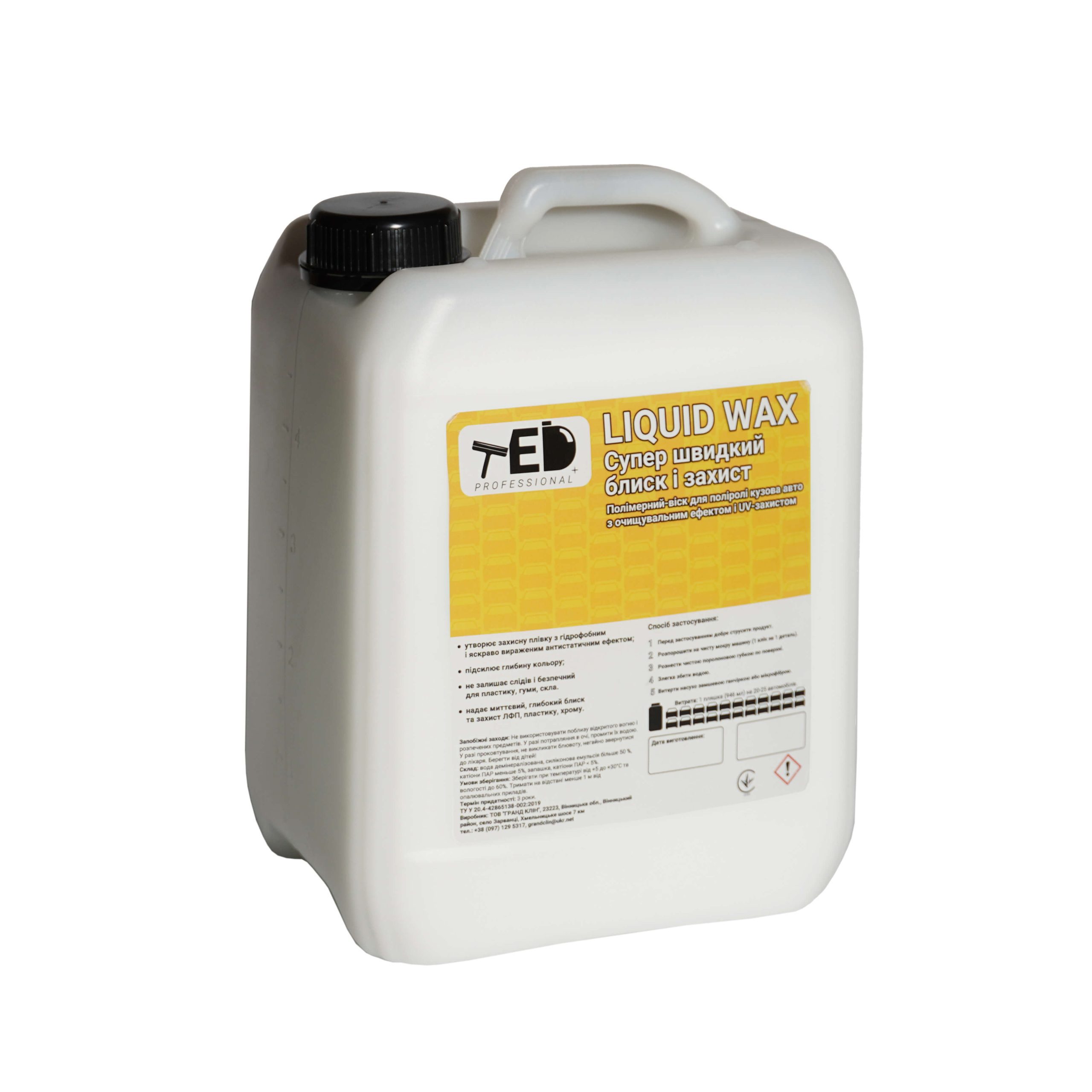
How a rapid dehumidifier works with liquid wax
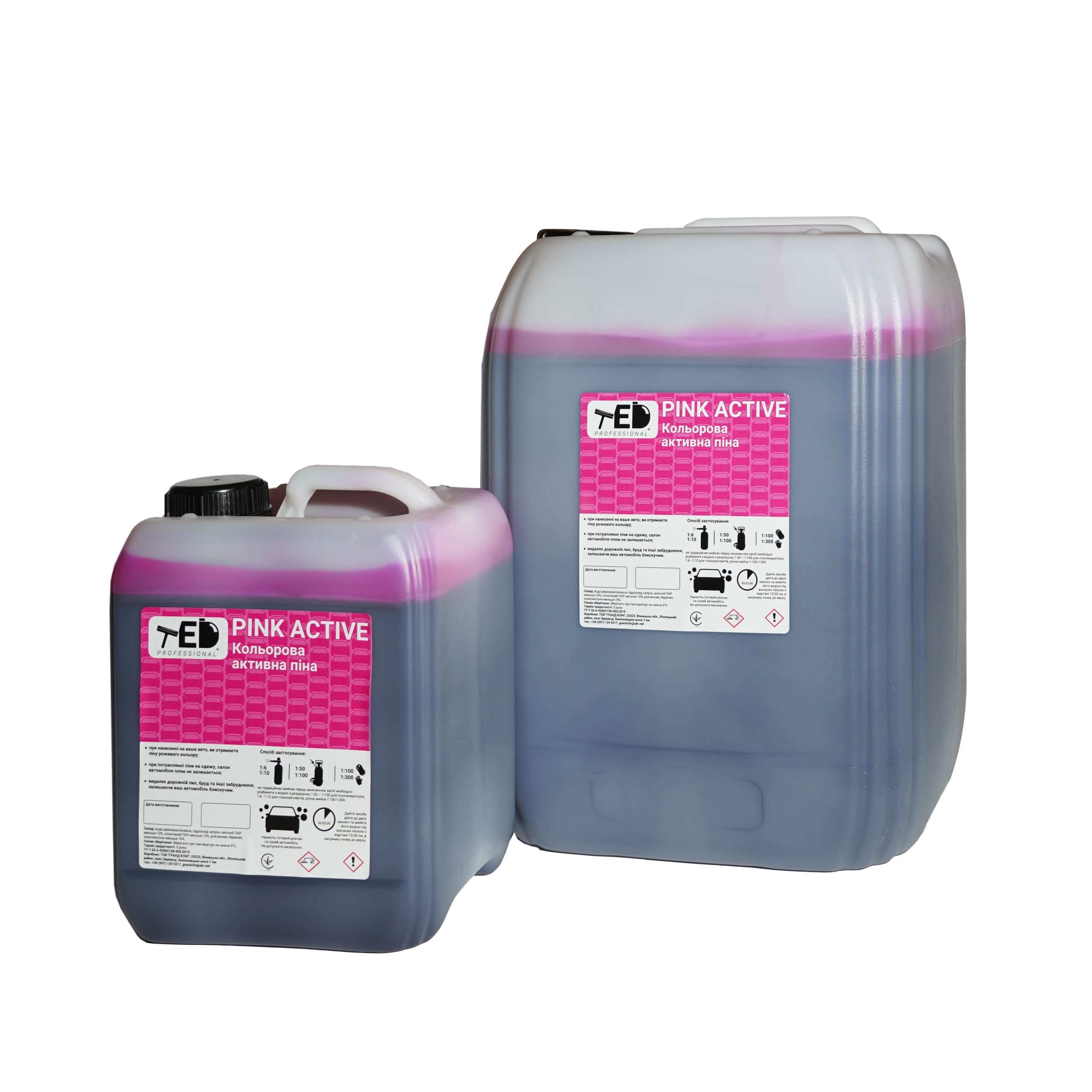
You can achieve the best results only by using a comprehensive range of professional car care products. That is why we recommend combining a pre-wash with Active Foam, professional wax, Super Quick Dryer (cold wax), and Liquid Wax. Each of these products serves a specific purpose, and together they form a complete system for fast and safe car care.
Super Quick Wax Dryer
+
Liquid Wax
=
✔ Quick drying
✔ extra shine
✔ water-repellent protection
✔ Makes the next wash easier
✔ Minimal water spots
TED Professional Expert Summary
As TED Professional experts, we are convinced that the final drying stage is one of the most time-consuming steps in professional car washing. Modern high-speed dryers work by applying the principles of surface physics, altering the surface tension of water and accelerating its natural runoff. This significantly reduces the number of manual steps, increases the car wash’s productivity, and simultaneously minimizes the risk of micro-scratches on the paint finish.
To achieve the best possible results, we recommend using a comprehensive approach: pre-cleaning with Active Foam, professional Super Quick-Drying Wax —cold wax 1:50 (concentrate)—and a final application of Liquid Wax. This technology ensures maximum speed, a deep glossy shine, reliable water-repellent protection, and a consistently high level of service for every customer.
Pink Active Foam – 1:100–1:300 (concentrate)
Price range: from 350 ₴ to 3,905 ₴Select options This product is available in several variations. You can select the options on the product page.Liquid Wax – Express Wax for a Wet Car Body, 3–5 min
Price range: from 650 ₴ to 1,800 ₴Select options This product is available in several variations. You can select the options on the product page.Super Quick-Drying Wax – Cold Wax 1:50 (Concentrate)
Price range: from 340 ₴ to 2,098 ₴Select options This product is available in several variations. You can select the options on the product page.